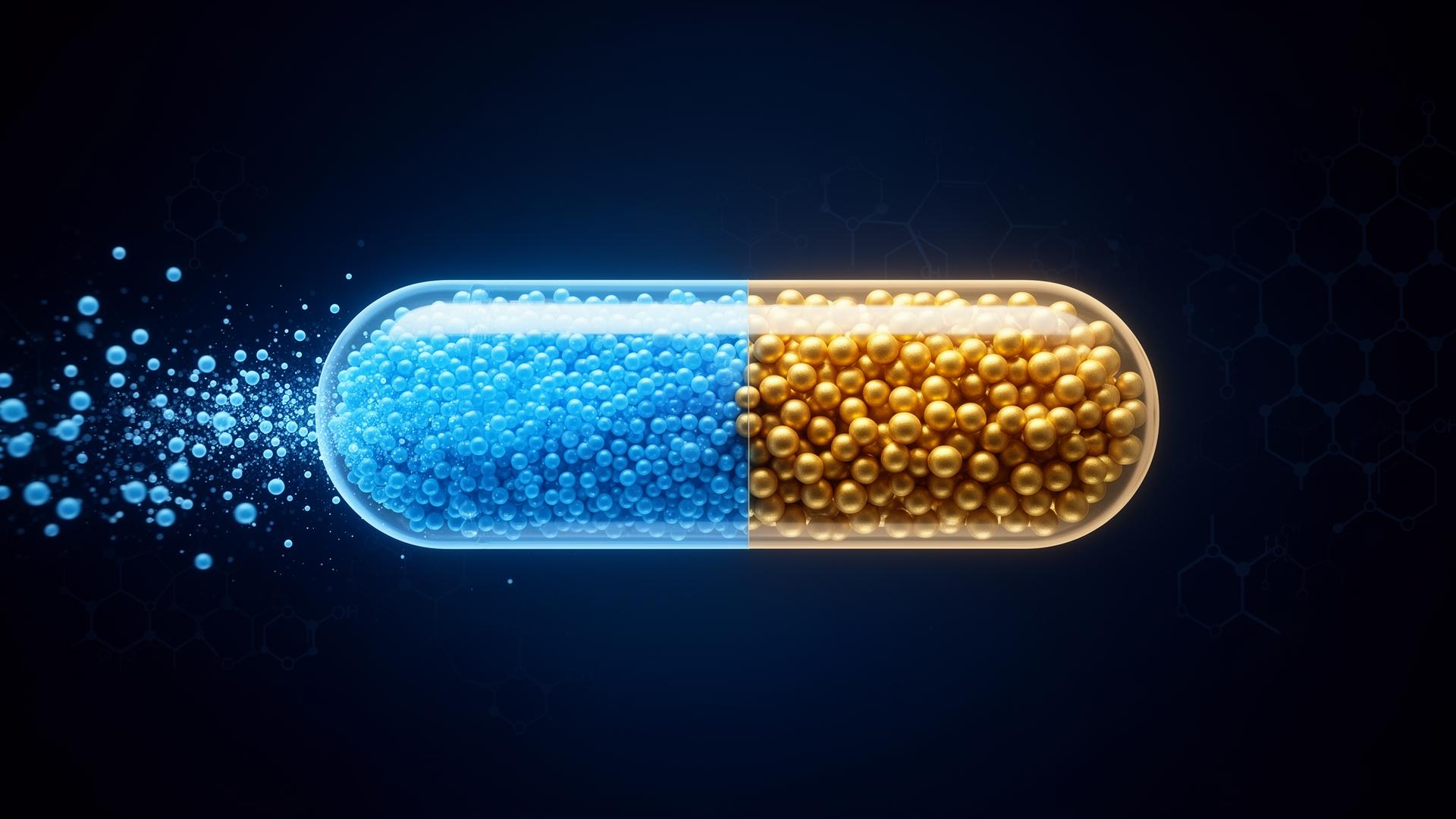
Biphasic Drug Delivery Platform — A Dual-Phase Release Architecture for Short Half-Life Pharmaceuticals
A patented immediate-release / delayed-release oral delivery platform applicable across a broad range of pharmaceutical compounds. Biphasic / Combo is presented in the patent as an illustrative example application — the underlying invention is a platform technology.
About this asset
Islet Sciences' flagship asset is a pharmaceutical delivery architecture, not a single-product patent. The platform engineers an immediate-release phase paired with a programmed delayed-release phase from a single oral dosage form — designed to improve the pharmacokinetic performance of drugs characterized by short half-lives, limited absorption windows, multi-dose regimens, or peak-to-trough fluctuations. Biphasic / Combo is the original example application disclosed in the patent.
Key characteristics
Potential applications
A new dosage form for short half-life medicaments.
US 10,940,159 B2 · Granted 2021 · Inventors: James Trinca Green & William Owen Wilkison · Current assignee: Islet Sciences, Inc.
From the patent"A combination immediate/delayed release delivery system for compounds which have short half-lives, such as the antidiabetic remogliflozin etabonate, is provided which delivers a dosage form that has two distinct phases of release — an immediate release of the compound upon ingestion and a second formulation which delays the release — so that a once-daily dosing regimen of remogliflozin etabonate may be achieved while providing effective control of plasma glucose and minimizing nighttime exposure."
How the biphasic platform works.
A live walk-through of a single dosage form — from administration through to a complete dual-peak pharmacokinetic profile.
- Stage 01Administration
A single oral dose is taken
One capsule, once a day. Inside: two engineered drug populations sitting side-by-side — an immediate-release fraction and an enteric-protected delayed-release fraction.
- Stage 02Stomach environment
Immediate-release phase begins
Within minutes, the IR layer dissolves in gastric fluid. Drug particles disperse and free molecules begin entering the bloodstream — establishing therapeutic coverage almost immediately.
Onset · 0–30 min - Stage 03Upper GI absorption
First plasma peak rises
Released drug crosses the intestinal epithelium and enters systemic circulation. Plasma concentration climbs through Peak #1 — the immediate-release event.
Peak #1 — IR - Stage 04Protected transit
Delayed-release component stays intact
The DR beads are shielded by a pH-responsive enteric coating. They resist gastric acid and continue through the GI tract, payload preserved.
Gastric protection - Stage 05Secondary release
Targeted dissolution at the absorption window
On reaching the targeted intestinal pH, the polymer coat dissolves and the DR fraction unloads — a second wave of drug molecules enters circulation hours after the first.
Peak #2 — DR - Stage 06Dual-peak pharmacokinetics
Sustained therapeutic exposure across the day
Two engineered peaks combine into a single 24-hour exposure profile — smoother peak-to-trough, fewer doses, differentiated product positioning.
24-hour coverage
A flexible pharmaceutical delivery architecture.
The platform was designed to support multiple formulation strategies and future product opportunities — not a single fixed product. Hover any component to explore.
pH-responsive polymer coatings (e.g. methacrylic acid copolymers) that remain intact in gastric acid and dissolve above pH ~5.5, protecting the delayed-release payload until it reaches the small intestine.
From a single product to a platform technology.
Most patents protect one molecule, one product. The biphasic architecture is engineered as a platform — the same delivery system applies across many compounds, formulations, and therapeutic areas.
- 01Traditional Patent
- 02One Molecule
- 03One Product
- 01Biphasic Platform
- 02Multiple Molecules
- 03Multiple Formulations
- 04Multiple Therapeutic Areas
- 05Multiple Product Opportunities
Coverage during the day. Quiescence at night.
The biphasic profile is engineered to maintain therapeutic exposure across the waking hours while minimizing nighttime drug levels — a PK shape broadly applicable to short half-life compounds across many drug classes.
- Rapid Peak
- Rapid Decline
- Sub-Therapeutic Trough
- Immediate Release Phase
- First Therapeutic Exposure
- Delayed Release Phase
- Second Therapeutic Exposure
- Extended Coverage
Illustrative pharmacokinetic profile for explanatory purposes — not clinical study data.
Remogliflozin — the example application disclosed in the patent.
The patent uses remogliflozin etabonate, a short half-life selective SGLT2 inhibitor, as the worked example to demonstrate the biphasic platform. Remogliflozin is presented as proof of concept — not the sole commercial opportunity. The underlying intellectual property is a delivery architecture applicable to a wide range of pharmaceutical compounds.
Standard remogliflozin formulations require multiple daily doses because of the compound's short half-life and absorption profile. The Islet Sciences platform was developed to potentially enable once-daily administration — and the same architecture may be applied to many other short half-life compounds across therapeutic categories.
Statements on this page describe the patented technology and its design objectives. They are not intended to characterize regulatory status, clinical efficacy, or approved use.
- Class
- SGLT2 inhibitor
- Indication area
- Type 2 diabetes mellitus
- Half-life
- Short
- Conventional dosing
- Twice daily
- Platform target
- Once daily
- Hypoglycemia risk (class)
- Low
- Aliases
- GSK 189075 · KGT-1681
The two components of the biphasic combo dosage form.
A single oral unit carries two functionally distinct components — an immediate-release (IR) fraction and a delayed-release (DR) fraction — engineered together to act as one programmed combination therapy from one swallow.
The IR fraction dissolves rapidly in the gastric environment to deliver a fast onset of action — establishing therapeutic plasma levels within the postprandial window.
- Form factor
- Uncoated IR layer / matrix / fill
- Site of dissolution
- Stomach (pH 1–3)
- Release kinetics
- Rapid · within minutes
- Pharmacologic role
- Onset · early Cmax
- Approx. load share
- ~30–50% of total dose
The DR fraction is enteric-protected, transiting the stomach intact and releasing downstream — producing a second exposure peak that extends daytime coverage without requiring a second pill.
- Form factor
- Enteric-coated layer / core / beads
- Site of dissolution
- Small intestine (pH 6–7)
- Release kinetics
- Delayed · programmed onset
- Pharmacologic role
- Sustain · second Cmax
- Approx. load share
- ~50–70% of total dose
Six commercial reasons this matters.
Patient Convenience
Consolidates multi-dose regimens into a single oral administration.
Potential Once-Daily Dosing
Single morning dose engineered for full daytime coverage.
Product Differentiation
Distinct PK profile vs. immediate-release competitors and generics.
Patent Extension Strategy
Composition and method-of-use protection through 2034.
Lifecycle Management
Reformulation pathway for marketed short half-life compounds.
Commercial Exclusivity
Defensible position for licensees building differentiated products.
A platform opportunity beyond a single compound.
The platform's biphasic delivery architecture is applicable to a broad set of short half-life pharmaceuticals across therapeutic categories — providing multiple potential revenue pathways through licensing, co-development, and lifecycle management.
Filed across four continents.
The patent family extends across the major global pharmaceutical markets, providing licensees with worldwide and regional rights structures suited to their commercial footprint.
From filing to commercial protection through 2034.
- 012011Priority FilingApplication US13/809,222 filed July 7, 2011.
- 022013PublicationPublication of US20130209563A1 (Aug 15, 2013).
- 032021Patent GrantedIssued March 9, 2021 as US 10,940,159 B2.
- 042034Adjusted ExpirationTerm-adjusted expiration September 26, 2034.